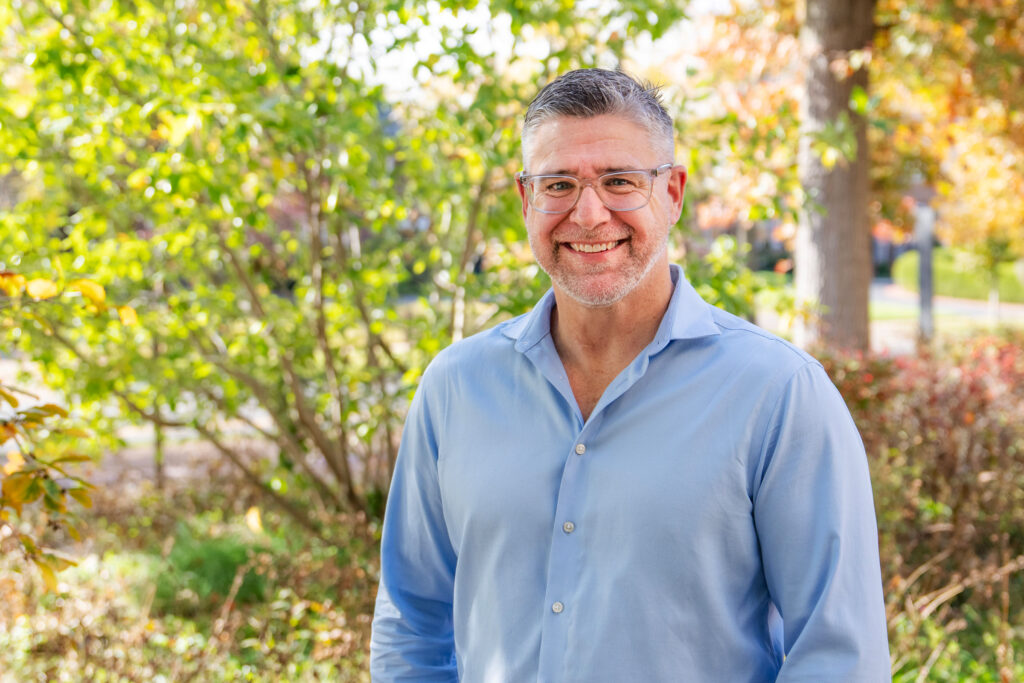
Joe Steensma can track a Lincoln’s sparrow through dense underbrush and navigate the complexities of capital markets with equal facility. Steensma — a WashU Public Health professor of practice, an entrepreneur who has founded several businesses focused on advancing public health, and an author of three field guides on birds — brings an unusual combination of skills to his work. His approach to solving public health problems stems from the same careful attention required to navigate the natural world.
“When you spend as much time in nature as I do, one becomes very observant and discerning,” said Steensma, MPH, MA, EdD, “and for me, those skills show up when I am trying to understand problems and processes in complex systems, be it in a factory, a fish-farm, a hospital, and anywhere else, but especially when I am looking at public health. Because of a lifetime of looking for details, I think I see things that some people don’t see.”
Steensma, who considers himself a problem solver as opposed to a “discipline-based scientist,” wants his students to understand that the analytical tools they’re learning how to use as epidemiologists, biostatisticians, and health policy experts in training are also very useful in other domains, including in launching businesses aimed at solving public health challenges.
But the integration of business and entrepreneurialism with public health is generally missing from the world of public health. This, Steensma said, represents a great opportunity for the discipline of public health, and a particularly unique opportunity for WashU School of Public Health.
“Our philosophy among the faculty in public health is not anti-entrepreneurialism,” he said. “It’s the opposite. In public health, the skills that you develop as a public health professional — the ability to see more problems and to understand them more completely; the transdisciplinary and sans-disciplinary, which implies ‘without discipline,’ approaches that we use in tackling big public health problems — it’s exactly what entrepreneurialism and capitalism need.”
Steensma’s path to this unconventional position in public health began when he was just 7 years old. He had to give a class presentation on someone famous from his hometown. He chose Alice Hamilton, the pioneering occupational health physician-scientist for whom the park in Fort Wayne, Indiana, where Steensma played Little League Baseball, was named — and, Steensma said, arguably the most important figure in American public health in the past 150 years. Decades after that class presentation, Steensma became an industrial hygienist, working to make the workplace less dangerous, as Hamilton had done. He sees the connection as more than coincidence — an “invisible hand” guiding him toward work that mattered.
A job involving nuclear physics at Argonne National Laboratory and the U.S. Department of Energy gave him expertise in physical, chemical, and biological hazards. His time wandering in the woods taught him to see the details within larger systems. Combined, these experiences helped shape someone well-positioned to translate between the language of public health and the language of business.
Here, Steensma talks about his approach to public health; capitalism; and how lessons from wildlife inform his approach to work.
Q: Can you describe what you do day to day at WashU regarding public health?
“As a professor of practice, I’m teaching, I’m conducting research, and I am working in the field. I’m trying to understand the sort of dynamism or interaction between practice and knowledge, and I teach our students how to do the same. I try to teach them how to integrate new and emerging knowledge from books and journals into a practice that can be sustained. And I try to bring the practice of public health back into the classroom so these three things — existing knowledge, emergent knowledge and praxis – can be brought together to maximize the utility of each.
“What I do in public health is find problems that I think need to be solved, and I work on them. If I need to acquire a skill or knowledge, I trust that I can. If I can’t acquire it quickly enough and there are people who are more skilled, then I just go out and work with them. A lot of times, I would prefer to harness the power of enterprise to solve such problems, and to leverage capital markets and leverage the system of capitalism to disseminate science and disseminate good rather than rely on the slow but still important process of journals and publications.”
Q: What is the benefit of harnessing capitalism to make it work for public health?
“We have been taught to believe that capitalism and the system are bad. That it’s inherently rigged. The truth is that everybody’s life — virtually everybody’s life — is better because of it. And that’s a bitter pill for people to swallow because they see the inequities of it. They see that it’s unfair; they see what it leads to.
“But we have to give the market a chance to invest in our solutions. When we don’t invite the market to participate in public health, when we don’t give them the opportunity because we want to push against capitalism, the only thing they can invest in is health-care companies, which is to say they invest in the public’s sickness. When we give the market a chance to invest in public health solutions, we introduce opportunities that combat illness instead of feeding it.”
Q: Tell us about the class you teach called “Endgame.”
“Endgame is the nickname for a class called ‘Endgame for Entrepreneurship: Leveraging Capitalism for Good.’ It is an undergraduate class I teach with my incredibly innovative colleage, II Luscri from the (WashU) Skandalaris Center. In the class, we’re trying to get students to understand the systems in which society operates. If we look at capitalism, it’s simply an operating system for society. It’s a financial system, an operating system for finance, and to translate value universally — I value your work, you create value, you get paid, you can spend that value in ways that you see fit. You can spend it on an iPhone or however. But it’s all about an exchange of value.
“What we do in that class is deconstruct the entire system. And this is an undergraduate class, not many business majors. Actually, most of them are not business majors. That’s what we want because we want nonbusiness majors to understand that they can play this game, too. First, we deconstruct this operating system. We find that no matter what it is, all operating systems can produce inequities. All of them can create unfairness. Some operating systems incentivize certain things that we may want in society. A socialist operating system incentivizes one set of things. A capitalist system incentivizes another. And what capitalism does is incentivize innovation and investment in problem-solving. Full stop. We can talk about the inequities of it. That’s fine. It will produce those. But it will, and does, foster — if done correctly, which we can argue — innovation and problem-solving.
“What we try to do is teach the operating system of capitalism, and then we teach the framework of how to solve problems. That framework that we use in the class to analyze our capitalist system is called the United Nations Sustainable Development Goals. Is it perfect? No. Does it tick every box? No. But it’s a system for us to identify, quantify, prioritize, and measure progress toward these goals.”
Q: What are your aspirations with the new School of Public Health, especially regarding entrepreneurialism?
“The knowledge, skills and abilities that students develop through an education in public health suit them extremely well as entrepreneurs. The only thing that’s missing, just one thing, is the lexicon of enterprise. And what I aspire to do is to demystify that thing — enterprise. Demystify terms like ‘revenue,’ ‘return on equity,’ ‘balance sheets,’ ‘customer acquisition costs’ — demystify all that stuff.
“Compared to linear modeling, compared to understanding the complexities of biostatistics and epidemiology, compared to that — learning how to read a balance sheet and accounting, that’s the easy stuff. What I want to do is give our students an opportunity to learn that so they can take their seat at the table of enterprise. So many of us have abdicated our place at the table that there are few people left who intend on leveraging the system of capitalism to maximize the good it is capable of doing.”
Q: How has the natural world shaped your approach to public health and entrepreneurship?
“There are so many things I’ve learned that connect very closely to my work in public health. First, as a fisherman, one of the things that I tell my kids is a quote from Izaac Walton: ‘When baiting a frog, do so as if you love him.’ The idea is that you are never cruel. You never do things out of cruelty. You don’t do things to inflict pain.
“And then what that does is it teaches you a reverence for life. It means that you value all creation. So why is that important? For me, if I can be steeped in and raised in the woods as I was, and I could look upon the ant with fascination and be enamored by the beauty of a beetle, then how much more valuable will I see a human life? If I can’t walk past an injured snail, then I won’t be able to walk past a sick human or a person who’s downtrodden. So being an observer of nature, it’s given me just a reverence and perspective on life.”
Writer
Hayley Abshear is the School of Public Health’s digital content strategist and social media coordinator. She holds a bachelor’s degree in journalism from Webster University and was previously a freelance writer for national publications and a content creator at a PR firm. She brings almost a decade of experience in writing, content strategy and social media marketing to the team.