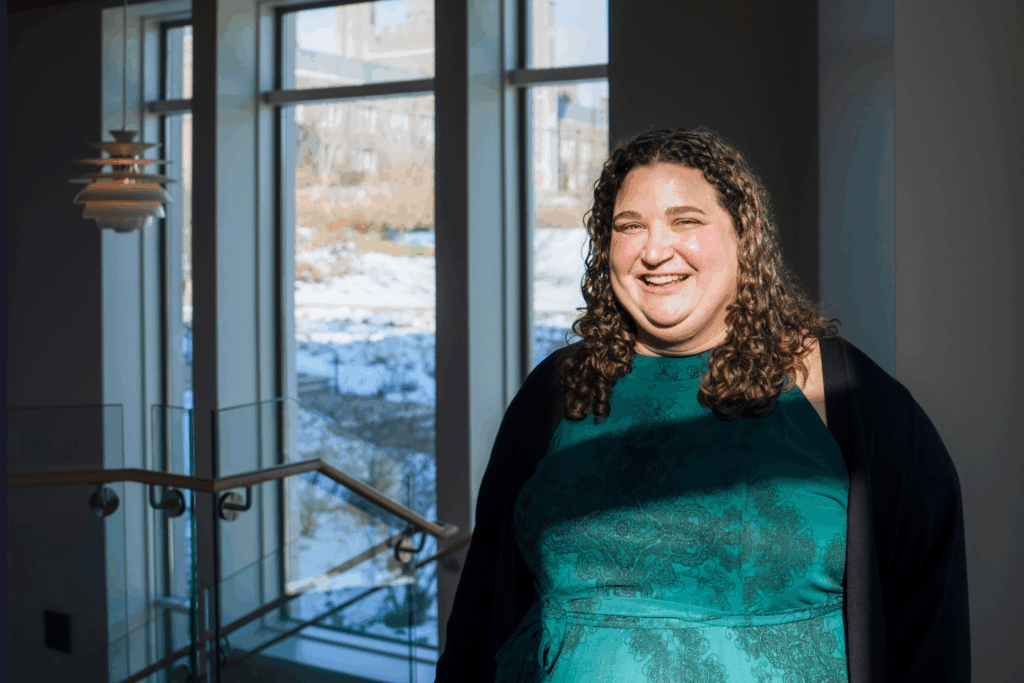
Nicole Strombom was helping with vaccine policy for a member of the California State Assembly in 2012 when it occurred to her that she didn’t know how the laws and policy efforts she was helping with would actually affect people and their health. This realization eventually led her to the field of legal epidemiology, which studies how the law affects the causes, distribution and prevention of disease.
“When I was a policy writer, I was put in an ethical and moral dilemma where I knew that I was changing how the world functions for people, but I didn’t actually have any quantifiable scientific evidence-based background to know if what I was doing was going to help people the way we hoped it would,” Strombom said.
This month, Strombom became the first PhD student in Public Health Sciences to graduate from the School of Public Health at Washington University in St. Louis. Her dissertation — titled, “Family and Medical Leave Act and Childhood Secure Attachment: Are We Doing Enough to Ensure Children Establish Good Patterns for Lifelong Health?” — explored how policies affect parents’ ability to promote secure attachment with their infants. Children who are securely attached to their parents grow up to have reduced risk of anxiety, depression and stress-related illnesses such as heart disease and high blood pressure. Her dissertation committee was chaired by Ross Hammond, PhD, the Distinguished Professor in Public Health System Science at the School of Public Health.
The research is deeply personal. While working toward her PhD, Strombom gave birth to two children, now ages 2 and 4. With each pregnancy, she recognized how fortunate she was to have access to quality health care and paid leave, and how many families lack these basic supports. Her children, she said, are the reason she does this work.
“I see it as my responsibility as a public health professional to help build a better, more equitable system so that every birthing person has the resources they need to be healthy and their children can flourish,” Strombom said. “I would not be as good a researcher or mentor to my students without having children. That’s why I’m passionate about this. Because it’s not just about me.”
As she wraps up her time at WashU, Strombom reflects on her experience at the School of Public Health — and, before the school launched, the Brown School — and her commitment to teaching the next generation of public health professionals about the critical intersection of law, science and policy.
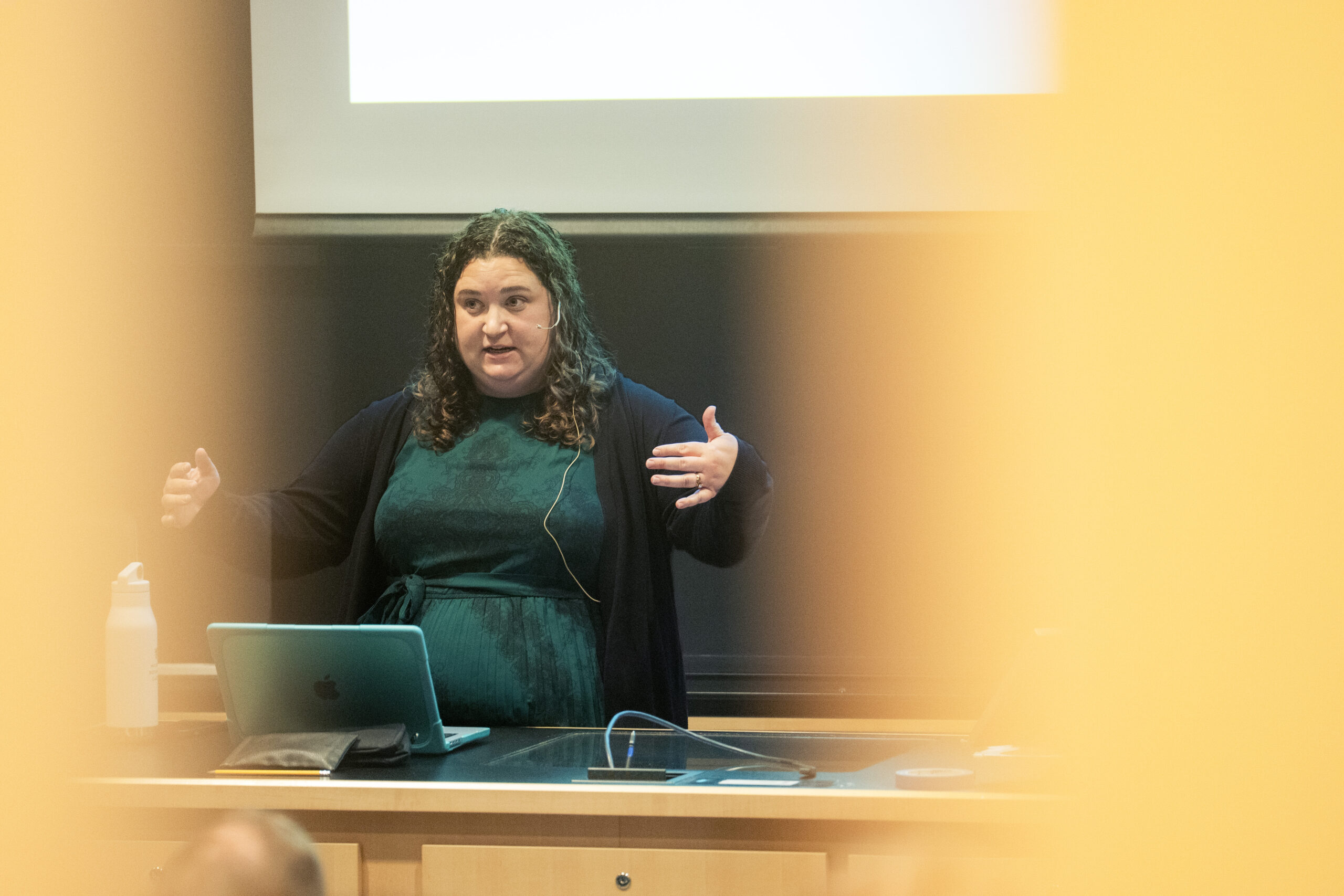
Q: How did you come to learn about legal epidemiology?
“My journey begins back in California in 2012. I was an intern for a member of the California State Assembly, Dr. Richard Pan, who was working on vaccine law. I got to see the entire process — from ideation to passing of laws — of how we can make policies that make the world a better place for our children. After that, I became a lobbyist in California for three years, helping write health policy. But I felt unqualified. I was writing law, but I didn’t really know what the law was going to do to people.
“At that point, I decided it was time to go to law school, but I also wanted to have a scientific background, so I got a master’s degree in public health as well. I moved to St. Louis in 2016 to do both degrees at Saint Louis University, graduating into the pandemic. I was introduced to legal epidemiology through an internship at the Centers for Disease Control and Prevention (CDC) in 2019 and remember thinking, ‘This is what I have been looking for.’ My mentor at the CDC, Montrece McNeill Ransom, who also serves on my dissertation committee, said, ‘If you don’t get your PhD now, you probably will never get it.’ That’s when I applied to WashU for my PhD in Public Health Sciences.”
Q: What drew you to legal epidemiology?
“My mom had double neck surgeries when I was in high school, and my mom is a single parent. These surgeries led her to be basically bedridden for the majority of the year. I’m the second child, so I have an older sister, Renee Sears, who earned her PhD at WashU in Human and Statistical Genetics, and Renee did a lot of work to make sure our family unit was OK. But we live in a society that really doesn’t have any safety nets for situations like that, really doesn’t have safety nets for families, and really doesn’t take care of single parents.
“Working in Dr. Pan’s office was a pivotal experience. He is a father, and he had to balance family life while being a politician and a physician. His own family motivated him to make sure we were making good policies for other families. So that, plus my mom’s experience, just put me in the right place to pursue a career moving the needle for health policy.”
Q: How can workplaces benefit from having the right policies in place?
“In the policy world, we have ‘big P’ policies and ‘little p’ policies. The big P are legal codes and things that are written in HR manuals, for example. And then we have little p, which is the systematic way that things function. Little p policy changes can be implemented into a workplace without having to wait for changes on a city or state level. If you have policies that are family-unfriendly, you’re going to lose some employees, and losing an employee costs a lot of money. So, if you can change management policies, if you can be more compassionate, more empathetic to parents in the way that you function as a business, you’re going to keep good employees.”
Q: What makes you passionate about your work?
“Right when I was starting at WashU, I had a miscarriage. Then my daughter Luiza was born in September of my second year in program, and Sarah was born in October 2023, which was my fourth year in the program.
“That experience really helped me home in on what type of policy I was going to focus on for my dissertation. I love my daughters. Until you’re part of a system and until you’ve seen the functionality of a system directly not work for you, sometimes policy seems nebulous. Having my daughters expanded my understanding of policies impacting birthing persons.
“Recognizing all of that means that I have a vested interest in making sure the world and policy isn’t just functioning for me as a privileged white cisgender woman. And realizing how much I struggled postpartum, even with what I was given. Once I had Luiza, I ended up with severe postpartum depression. And it took me a little over a year to get out of that fog.
“And after I had Sarah, we finally figured out why I have been sick for a very long time, which is because I have a primary immunodeficiency disease. I have been very lucky to have the health care and the privilege that I’ve had to be able to figure these things out, have the doctor’s appointments I need to get the care that I need, to get the medication that I needed to deal with the mental health issues that I had after I had Luiza. And there are many people who do not get that.”
Q: Where are you going next?
“I am applying broadly to positions where I can use data to create evidence-based policy that impacts family life and will make accessing care easier and our populations healthier. What does that mean? I’m applying to jobs in insurance. I’m applying to professorships. I’m applying everywhere other than federal agencies. Do I know what I will find? No.
“My ideal would be a position that involves some research and a lot of teaching or mentorship. I want to keep working on my evidence-based research, but I also want to be mentoring the future generation that is going to be taking over this work. I’m teaching a health administration and policy class right now, and getting to teach this course has been a highlight of my career as a doctoral student. I love sharing ideas. I love to teach.”
Writer
Hayley Abshear is the School of Public Health’s digital content strategist and social media coordinator. She holds a bachelor’s degree in journalism from Webster University and was previously a freelance writer for national publications and a content creator at a PR firm. She brings almost a decade of experience in writing, content strategy and social media marketing to the team.