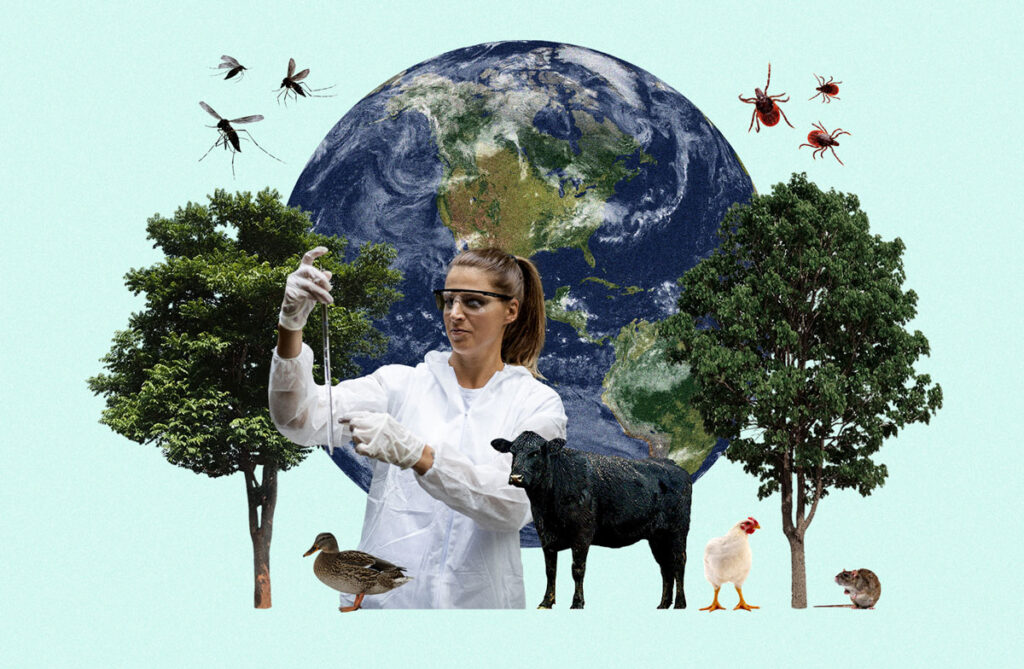
Climate change is disrupting the ecological balance of the planet in ways that increase the threat of infectious disease to people, wildlife and domesticated plants and animals.
As the planet warms, the ranges of disease-carrying mosquitoes, ticks, flies and mites are shifting, introducing bacterial, viral and parasitic diseases to new regions and populations. Pathogenic fungi that live in the soil or water are thriving in areas that were once inhospitable to them, leading to more dust-, air- and waterborne fungal infections in people. Disrupted rainfall patterns can lead to flooding, which increases the risk of drinking water becoming contaminated with sewage, and warmer ocean and freshwater temperatures can lead to toxic blooms of disease-causing bacteria and algae.
Add to all that the risk of spillover, which happens when a virus, bacterium or parasite that normally circulates in wildlife infects a person. Animal pathogens typically aren’t well-equipped to spread easily among people, so most spillover events result in only one or a few people getting sick. But occasionally, a spillover event can erupt into an epidemic, such as the 1918 flu epidemic, Ebola outbreaks and, most likely, COVID-19. Habitat destruction due to climate change and other human activities like livestock and wildlife trade are increasing encounters between people and wildlife, making it more likely that spillover events will occur.
To address the intertwined crises of emerging diseases and a warming planet, the School of Public Health at Washington University in St. Louis will bring leading experts from research, policy and health care together on January 21 for the symposium “Disease Ecology on a Changing Planet.” The event is the inaugural convening of the school’s Solutions through Planetary Health Research (SPHERE) Innovation Research Network, which aims to catalyze innovative, cross-disciplinary research to strengthen understanding of the effects of changes to the environment on human health, and to find sustainable ways for people to live healthier lives while maintaining the health of the planet that supports us all.
The event will take place from 9 a.m. to 12:30 p.m. CT in the Clark-Fox Forum in Hillman Hall on WashU’s Danforth Campus. It is free and open to the public in person or via Zoom. Registration is required.
The convening will open with remarks by Sandro Galea, MD, DrPH, the Margaret C. Ryan Dean of the School of Public Health, the Eugene S. and Constance Kahn Distinguished Professor in Public Health and the vice provost for interdisciplinary initiatives at Washington University — followed by two panel discussions.
The first panel, “Interconnected Health: Linking Human, Animal, and Environmental Health,” will explore the factors that shape disease emergence and transmission. Bringing perspectives from disease ecology, wildlife health, systems science, and medical research, panelists will discuss when, where and why new diseases are likely to emerge, and how we can reduce disease risk to people and wildlife while conserving biodiversity.
The second panel will open with a keynote speech by Neil Vora, MD, the executive director of Preventing Pandemics at the Source Coalition and senior adviser for One Health at Conservation International. A physician, epidemiologist and conservationist, Vora champions bold, science-driven solutions that bridge human, animal and environmental health. The panel, “From Insight to Impact: Translating Disease Ecology Research into Policy and Practice,” will explore pathways for translating evidence into effective public health strategies, policies, entrepreneurial opportunities and community-level interventions.
“This convening will bring world-leading experts here to WashU for a dialogue at the intersection of emerging disease and climate change,” said Dan Giammar, PhD, the Walter E. Browne Professor of Engineering at WashU’s McKelvey School of Engineering, a professor of public health, the director of WashU’s Center for the Environment, and the co-director of SPHERE. “It’s a chance to share knowledge and ideas and spur collaboration between the environmental science community and the public health and medicine communities. WashU is very strong in these fields, but up to now we haven’t really taken full advantage of the opportunities that come from having multiple world-class research communities in one place to build the connections we need to tackle the big problems.”
SPHERE is one of six Innovation Research Networks at WashU Public Health. These novel networks are a key part of the school’s research enterprise. They serve as dynamic research hubs to catalyze interdisciplinary connections to generate new ideas and collaborations and accelerate progress toward solving critical public health problems.
Writer
Tamara Schneider, MPH, PhD, is the senior science writer and assistant director of communications for WashU School of Public Health. She holds a bachelor’s degree in molecular biophysics & biochemistry and in sociology from Yale University, a master’s in public health from the University of California, Berkeley, and a PhD in biomedical science from the University of California, San Diego.